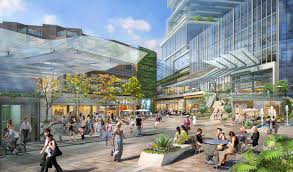
Walk down Western Avenue in downtown Muskegon and you can read the last fifteen years of West Michigan planning in a single block. Apartments sit above breweries, storefronts open onto the sidewalk, and the building with a coffee shop at street level holds people who live two floors up. That is mixed-use development, and local planners are not quietly tolerating it. It is the pattern they are rewriting their zoning codes to attract. For an owner thinking about putting an old downtown building back to work, the question is whether you are fighting the direction your city is moving or building with it. The ones who do well around here are building with it.
What mixed-use actually means on the ground
Mixed-use is exactly what the name says: more than one use sharing a single property or block. Most often that is residential stacked over commercial: lofts above a retail bay, offices above a restaurant, live-work units where the owner runs a business downstairs and sleeps upstairs. What separates it from a strip center is that the uses support each other. The people who live there are customers for the shops below, the shops draw foot traffic that makes the apartments more desirable, and the block stays busy at different hours instead of emptying out at five o'clock. West Michigan's better examples, from Muskegon's lakefront corridors to the older bones of downtown Grand Haven and Holland, all lean on that idea.
Why West Michigan cities are pushing it
The shift is written into how Michigan communities plan. Most municipalities operate under a Master Plan that lays out where growth should go, and a growing number have gone through the state's Redevelopment Ready Communities program, run through the Michigan Economic Development Corporation, which rewards cities for making their approval process predictable and their zoning friendly to compact infill. A city that earns that designation is signaling to developers that the path through City Hall is mapped out rather than improvised.
The economics favor it too. A mixed-use building generates far more tax base per acre than a single-story retail box surrounded by parking, and it does so without forcing the city to extend new roads, sewer, and water to the edge of town. Filling a vacant downtown lot uses infrastructure that already exists. For a smaller West Michigan city watching its budget, that math is why so many have rewritten their codes to make these projects easier.
The quiet revolution: form-based codes
The most important zoning change happening around here is also the least visible, and it directly affects what you can build. Traditional zoning is use-based. It draws a district, declares it residential or commercial or industrial, and keeps the uses apart. That made mixing housing and retail on one parcel difficult or impossible, which is a large part of why older downtowns, built before that kind of zoning existed, often could not legally be rebuilt the way they were first laid out.
A growing number of Michigan communities have shifted toward form-based codes, sometimes applied only to a downtown overlay rather than the whole city. A form-based code cares less about what happens inside the building and more about its form: how tall it is, how it meets the sidewalk, where the parking sits, whether the ground floor faces the street with real windows and doors. Under that framework, putting apartments over shops is the outcome the rules were written to produce rather than a fight against them. If you are evaluating a property, the most useful thing you can do early is find out whether the parcel falls under a conventional district or a form-based or mixed-use overlay, because that one fact reshapes everything else.
The money that can be stacked
Mixed-use and adaptive reuse projects can often layer more than one source of public support, which a plain single-use build rarely manages. The familiar names in Michigan include the MEDC's Community Revitalization Program, Brownfield Tax Increment Financing that can reimburse cleanup and certain infrastructure on a contaminated or functionally obsolete site, federal and state Historic Preservation Tax Credits for qualifying older buildings, and local tools like facade grants or Downtown Development Authority support. The dollar amounts and eligibility rules change over time and vary from one community to the next, so treat any figure you hear as a starting point to verify. Incentives like these can turn a building that does not pencil out at full private cost into one that does. The city's economic-development staff, and a developer who has done it before, will tell you which programs a project can realistically reach.
The building-code reality
Combining uses under one roof also combines building-code requirements that would otherwise live in separate buildings. Michigan construction is governed by the state's adopted building code, and when residential, assembly, and commercial occupancies share a structure, the design has to satisfy each one: fire separation between the dwelling units and the commercial space below, sound insulation so the tenants upstairs are not living over a tap room, accessibility, and separate egress paths. None of this is exotic, but it is more involved than a single-use build, which is why you bring in an architect and a code-savvy contractor early. Many smaller Michigan cities also require site plan review before issuing a permit, so the design conversation needs to start well before anyone orders materials.
The risks worth naming honestly
This is not a free lunch. Construction on a mixed-occupancy building generally costs more per square foot than a comparable single-use project because of those separation and systems requirements. Zoning is not always settled either; a parcel may need a variance, a rezoning, or a public hearing where neighbors get a say. And once the building is up, you are managing more than one kind of tenant, since a residential lease and a commercial lease behave and break in different ways, which calls for real systems rather than a casual landlord touch. The move that most reliably shortens the timeline is engaging the city's economic-development staff early, because the people who run the approval process can tell you where the real obstacles are long before they cost you months.
The bottom line
Mixed-use development is reshaping West Michigan downtowns and waterfronts, and for the right owner it offers diversification and long-term value when done with eyes open. The work is in reading the zoning correctly, understanding which incentives a building can reach, and building a team that has done this before. If you are looking at an adaptive-reuse or mixed-use opportunity in Muskegon, Grand Haven, Holland, or the surrounding markets, I am glad to help you understand the zoning overlay on a parcel and connect you with developers, architects, and economic-development contacts who can tell you what is real. The future of real estate here is not just square footage. It is what a building does for the block around it.