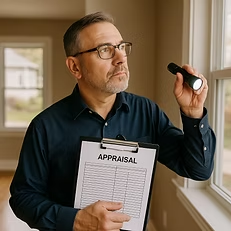
You accepted a strong offer. The buyer is qualified, the inspection went fine, and you are already mentally packing boxes. Then the lender's appraisal comes back lower than the price you agreed on, and your stomach drops. Take a breath, because a low appraisal does not end a deal on its own. It opens a new conversation, and the sellers who lose here are almost always the ones who panic. The ones who stay calm and come back with real data usually keep the sale together. Here is how the appraisal works and the moves that are genuinely on the table when it comes in short.
Why the appraisal exists in the first place
When a buyer is financing the purchase, the lender is putting up most of the money, so it wants its own independent opinion of what the home is worth. That is the appraisal. A licensed appraiser visits the property, measures it, notes its condition, and compares it against recent sales of similar homes nearby, the comparables, to set a value. The lender will only lend against that appraised value, not the contract price. So if you agreed to $300,000 and the appraisal says $285,000, the lender treats $285,000 as the ceiling for its loan. That $15,000 difference does not disappear. It has to come from somewhere, and figuring out where is the whole negotiation.
Why it sometimes comes in low
An appraiser is not weighing your memories of the home or the heat of a bidding war, just recent comparable sales and strict guidelines, which means a low number usually traces to one of a handful of causes. Thin comps. If few similar homes have sold near you recently, the appraiser is working from limited data and tends to land conservatively. A hot offer. In a competitive market a buyer may agree to pay more than the most recent closed sales support, and the appraisal simply catches up to that gap. Condition. Deferred maintenance, an aging roof, or dated systems can pull a value down, especially against comps that have been updated. Timing. Closed-sale data looks backward, so in a fast-rising market the appraisal can lag what buyers are paying this month. In West Michigan that shows up most along the lakeshore and in the fast-growing townships, where values can move quicker than the comps keep pace.
Read the report before you react
Your first real move is to get a copy of the appraisal, through your agent or the buyer's lender, and actually read it line by line. Appraisers are careful, but they work with public records and limited time, and mistakes happen. Check that the square footage matches reality and that your finished basement, your addition, or your recent kitchen and bath updates were counted. Then study the comparables: are they genuinely similar homes, in your area, that closed recently? It is more common than people think to find a comp from a different school district, a smaller home, or a sale that is six or nine months stale. Small factual corrections can move the number more than you would expect, and unlike the market, a clerical error is something you can actually fix.
File a reconsideration of value
If you and your REALTOR® can show the appraiser worked from incomplete or weaker data, the buyer's lender can submit what is called a reconsideration of value. This is not a complaint or an argument over opinion. It is a formal request that the appraiser look again at specific evidence. The strongest packages are built on better comparable sales, ideally a few homes that closed recently, close by, and genuinely similar to yours, paired with proof of upgrades the appraiser may have missed and market data showing prices have moved since those comps closed. Appraisers do revise their values when the original data was thin and the new evidence is solid, so assemble a real case rather than simply objecting. A sloppy rebuttal rarely changes anyone's mind.
Renegotiate the gap
Sometimes the value holds even after a good rebuttal, and then it becomes a math conversation between buyer and seller. There are really only a few ways to close a gap. The buyer can bring extra cash to cover the difference, since lenders allow a buyer to pay above appraisal as long as they fund that part themselves. The seller can lower the price to meet the appraisal. Or the two sides split the difference and each give a little. None of these is automatically right. A buyer who is stretched thin may not have extra cash, and a seller with other interested buyers may decide to hold firm. I have sat at plenty of West Michigan closings where a buyer brought an extra five or ten thousand dollars and the seller met them halfway, and everyone walked away fine. A low appraisal is a negotiation, not a verdict.
What the appraisal contingency means for you
How much leverage each side has often comes down to the contract. Many financed purchase agreements include an appraisal contingency, which gives the buyer a defined window to renegotiate or walk away if the home appraises below the contract price, usually with their earnest money protected. If the buyer waived that contingency to win a competitive offer, the pressure shifts onto them, because backing out could put their deposit at risk. If it is in place, the buyer has more room to ask you to move. The exact rights and deadlines are contract and law questions, so lean on your agent for what your agreement says and a real estate attorney if anything is genuinely in dispute.
Remember that one appraisal is not forever
The number you got is a snapshot, not a permanent label on your home. Appraisals are tied to a specific loan and a specific moment. If the buyer changes lenders or switches loan programs, a new appraisal can sometimes enter the picture, though the rules vary by loan type and are worth confirming with the lender rather than assuming. Government-backed loans in particular can attach the appraised value to the property for a set period, exactly the kind of detail you want the buyer's loan officer to spell out before anyone moves. And if this deal does not close, your home goes back on the market with everything you learned, often priced and positioned more sharply than before. A value that looks short this quarter can look conservative two quarters later, so treat the report as information, not a sentence.
If you are staring at an appraisal that came in under your price here in West Michigan, do not make any sudden moves. Let me read the report with you, look hard at the comps, and figure out whether the right play is a reconsideration, a renegotiation, or simply holding your ground. There is almost always a path through, and it starts with staying calm.